Sports betting is gambling when it carries negative expected value which describes more than 95% of all betting activity. It becomes closer to investing only when exploiting genuine pricing inefficiencies through arbitrage or value betting strategies. The math is unambiguous. The distinction most bettors miss is not philosophical it is structural.
Scout Audit — Key Findings:
- More than 95% of online sports bettors are net losers over time (UC San Diego, 5-year study, 700,000+ participants)
- For every $1 bet on sports, net investment in equities falls by $2+ (Baker et al., 2024)
- Fewer than 5% of bettors have ever withdrawn more than they deposited
- Sure betting and value betting generate positive expected value but require bankroll discipline most bettors don't apply
- $200/month invested instead of bet becomes ~$119,000 over 20 years at 8% annual return
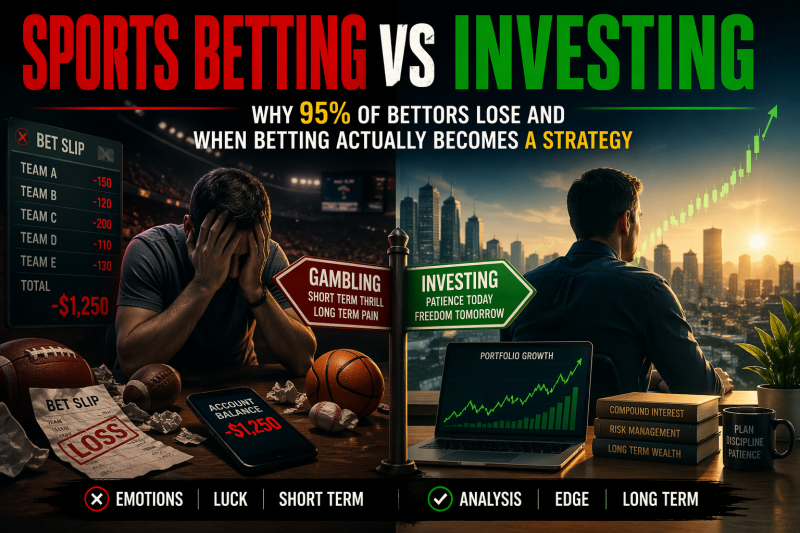
I spent twenty years watching people make bad decisions under financial pressure. The ones that stayed with me longest weren't the ones who committed crimes. They were the ones who believed, genuinely and completely, that one more bet was going to fix everything.
The question of whether sports betting is investing or gambling isn't philosophical. It's mathematical. And the math has a definitive answer but it's more complicated than most financial articles will tell you, because most financial articles aren't written by people who have actually tested both sides of it.
This one is.
Why This Question Matters Right Now
Prediction markets processed over $25 billion in monthly volume as of early 2026. Sports betting apps are available in the majority of US states. TikTok serves daily content about people turning $500 into $5,000 overnight. An entire generation is being told, through interface design and social reinforcement, that betting and investing are essentially the same activity with different aesthetics.
They are not. But the distinction is more nuanced than "gambling bad, investing good" and if you don't understand the nuance, you're vulnerable regardless of which side of the line you think you're on.
The Mathematical Foundation — Expected Value
Every financial decision, whether you're buying an S&P 500 index fund or placing a spread bet on the Chiefs, has an expected value. Expected value is the average outcome if you repeated that decision an infinite number of times.
Positive expected value means the math favors you over time. A diversified equity portfolio has historically generated approximately 7-10% annualized real returns over long time horizons. That's positive expected value not guaranteed in any single year, but directionally reliable over decades.
Negative expected value means the math favors the house. A standard -110 sportsbook line means you must wager $110 to win $100. That's a 4.55% margin built into every bet before any other factor enters the equation. On a 94% RTP slot machine you lose 6 cents per dollar on average, every spin, forever.
Zero expected value technically doesn't exist in commercial gambling because the house always extracts a margin to operate profitably.
This is the fundamental architectural difference between investing and gambling not the uncertainty of outcomes, which both share, but the direction of the mathematical expectation underlying the activity.
The Research Most Bettors Never See
A 2024 academic working paper by economists Baker, Balthrop, Johnson, Kotter, and Pisciotta analyzed transaction data from over 60 million Americans across roughly 230,000 households, tracking financial behavior before and after online sports betting became legal in their state.
The findings deserve to be read carefully by anyone who thinks of their betting as a side investment:
When sports betting became available in a state, losing participants didn't learn from their losses and reduce their wagering. They increased it. The addictive behavioral profile that platforms are designed consciously or not to cultivate produced the opposite of rational loss-aversion.
The money flowing into sports betting didn't come from entertainment budgets. It came from savings and investment. For every dollar directed toward sports betting, net investment in equities and other financial instruments fell by just over two dollars.
Fewer than 5% of online sports gamblers have withdrawn more money from their gambling apps than they deposited, according to a UC San Diego study of over 700,000 online gamblers tracked over five years through 2023.
Read that last number again. More than 95% of participants are net losers over time. This is not bad luck distributed across a population. It is mathematical inevitability built into the product by design.
Is Sports Betting Ever a Legitimate Investment Strategy?
Here is where I part ways with most financial publications on this topic and where twenty years of evidence-gathering instinct kicks in.
The answer is: yes, under very specific conditions that almost nobody meets.
Sure betting also called arbitrage betting exploits pricing discrepancies between different bookmakers to guarantee a profit regardless of the outcome. If Bookmaker A prices the Lakers at +150 and Bookmaker B prices the Celtics at +140 on the same game, you can bet both sides and lock in a 2-3% return with zero variance. This is not gambling. It is financial arbitrage applied to sports markets. The same mathematical principle is used in bond markets, currency markets, and commodity markets by institutional traders every day. Checkout RebelBetting's backtested data.
Value betting identifies situations where a bookmaker has priced an outcome at worse odds than its true probability warrants, and systematically bets those edges across hundreds or thousands of markets. Back tested data from major value betting software shows statistically significant positive yields over large sample sizes. This is closer to investing than to gambling.
But and this is the critical qualification that most sure betting content omits both strategies require:
A bankroll you can afford to lose entirely if variance runs against you in the short term. Disciplined, emotionless execution across hundreds of bets. Treatment as a long-term mathematical strategy, not a source of emergency income. Tolerance for account limiting at regulated books when you start winning consistently.
Someone betting because they're financially stressed, chasing losses, or treating it as a solution to debt cannot execute either strategy effectively. Financial pressure produces exactly the psychological conditions urgency, emotional decision-making, short time horizon that destroy any edge a mathematical strategy might provide.
The Opportunity Cost Nobody Calculates
There is a cost to gambling that doesn't appear in your account balance. It appears in what your money would have become if you had invested it instead.
$200 per month directed into sports betting at a 95% loss rate costs you $190 per month in expected losses. That's the obvious calculation.
The non-obvious calculation: $200 per month invested in a diversified index fund at a historical 8% annualized return over 20 years becomes approximately $119,000. The true cost of the betting habit isn't $190 per month. It's the $119,000 you didn't build.
This is what Charles Schwab's investment strategists call "the compounded future value of the investment that was never made." It's also what I watched happen, in real time, to people in financial distress who chose the lottery scratcher over the savings account not once, but thousands of times, until the boxes filled their apartment.
The opportunity cost of gambling is invisible. That's what makes it dangerous.
Why Gen Z Is Particularly Vulnerable
A March 2026 survey by Northwestern Mutual found that 80% of Gen Z respondents agreed with the statement: "I invest, or may invest, in high-risk or speculative investments because I feel financially behind."
That number is not surprising to anyone paying attention. Entry-level job scarcity, AI-driven employment anxiety, housing unaffordability, and student debt have created a generation that has watched the traditional wealth-building playbook fail for people who followed it faithfully. When the conventional path looks broken, unconventional alternatives sports betting, prediction markets, crypto, meme stocks look rational by comparison.
They're not. But the feeling that they might be is entirely understandable. That's the environment these platforms are designed to exploit not maliciously in most cases, but structurally. A platform whose revenue depends on continued wagering is not aligned with its users' long-term financial interests, regardless of the responsible gambling language in its footer.
The Specific Long-Term Damage
Financial stress from gambling doesn't stay contained to the gambling account. The academic research is unambiguous on the distributional consequences: adverse effects concentrate overwhelmingly among financially constrained households.
Among households that increased gambling after state legalization, the research found:
Credit card debt increased. Available credit decreased. Overdraft frequency rose. Net investment fell at rates far more severe than among financially stable counterparts.
The self-reinforcing quality of this pattern is what makes it most dangerous. The households most likely to be attracted by the possibility of a lottery-like windfall through online betting are precisely those with the least financial cushion to absorb the near-certain losses that follow.
A bet can be placed in seconds from your phone at 2 in the morning. The financial consequences are not reversible in seconds.
What Legitimate Sports Investing Actually Looks Like
After everything above, it's important to be precise about what separates gambling from something closer to sports investing because the distinction is real, not just semantic.
Gambling characteristics:
- Negative expected value by design
- Outcome determined primarily by chance
- No edge that compounds over time
- Losses increase participation (addictive profile)
- Money comes from savings and investment budgets
Sports investing characteristics:
- Positive expected value through identified edge (arbitrage or value)
- Outcome determined by pricing inefficiency, not chance
- Edge compounds across large sample sizes
- Losses reduce participation (rational economic behavior)
- Treated as an investment with defined bankroll and time horizon
The tools that bridge this gap sure betting software, value betting algorithms, arbitrage scanners exist and work. RebelBetting's backtested data shows 5.6% average yield per dollar invested going back to 2012 with statistical significance. OddsJam's coverage of 150+ US sportsbooks creates genuine arbitrage opportunities across regulated state books. These are real edges, not marketing claims.
But they are investment tools, not get-rich-quick mechanisms. Using them correctly requires the same discipline, patience, and long-term orientation that equity investing requires. The people who profit from them treat them exactly like that as a systematic, math-driven investment strategy applied to sports markets rather than securities markets.
The people who lose money with them treat them like gambling. The distinction isn't in the tool. It's in the operator.
The Scout's Conclusion
Sports betting is gambling when you're playing against a negative expected value with money you can't afford to lose, chasing outcomes rather than executing a defined system.
Sports betting is closer to investing when you're exploiting genuine pricing inefficiencies with a defined bankroll, across a large sample size, with the discipline to execute systematically, sure betting software, and the financial stability to absorb short-term variance.
The problem is that 95% of participants are doing the first thing while believing they're doing the second thing. That gap between what people think they're doing and what the math shows they're actually doing is where the financial damage lives.
The platforms aren't going to close that gap for you. Their business model depends on it staying open.
Your financial future doesn't depend on which platform you use. It depends on whether you understand the difference between owning and hoping and which side of that line your decisions are actually on.
Frequently Asked Questions
Is sports betting considered investing?
Sports betting is not considered investing in the traditional financial sense because most forms of betting carry a negative expected value the house margin ensures that participants lose money on average over time. However, specific strategies including sports arbitrage betting and value betting using algorithmic software can generate positive expected value under the right conditions. These approaches share characteristics with investing systematic edge, statistical reliability, long-term orientation but require a level of discipline and bankroll management that most participants don't apply.
What percentage of sports bettors actually make money long term?
According to a UC San Diego study tracking over 700,000 online gamblers across 32 states over five years, fewer than 5% of online sports gamblers have withdrawn more money than they deposited. This means more than 95% of participants are net losers over any meaningful time horizon. This figure is not explained by bad luck it reflects the mathematical structure of products designed with a house margin built into every wager.
What is the difference between gambling and investing?
The fundamental difference is expected value. Investing in diversified assets equities, bonds, real estate provides historically positive expected returns over long time horizons because you own claims on productive assets and future cash flows. Gambling products are structurally designed so that the operator extracts a margin from every transaction, producing a negative expected value for participants in aggregate. Both involve uncertainty and the possibility of loss, but the underlying mathematics point in opposite directions.
Can sports betting replace investing for building wealth?
No and the academic research is clear on this. A 2024 study tracking 60 million Americans found that for every dollar directed toward sports betting, net investment in equities and other financial instruments fell by just over two dollars. The money lost to betting doesn't come from entertainment budgets it comes from money that would otherwise have been saved and invested. The opportunity cost of that diverted capital compounds over time into significant wealth that was never built.
What is sure betting and is it actually profitable?
Sure betting also called arbitrage betting exploits pricing discrepancies between different bookmakers on the same event to guarantee a profit regardless of which outcome occurs. Because different books price events differently, covering both sides of the same market at the right odds locks in a 1-3% risk-free return per bet. Over large numbers of bets these compounds into consistent monthly returns. The primary challenges are finding sufficient arbitrage opportunities, managing account limiting at regulated US sportsbooks, and executing quickly before line movement closes the gap. When operated systematically with proper bankroll management, sure betting is mathematically profitable distinguishing it clearly from traditional sports gambling.
Why do most sports bettors lose money even when they win bets?
The primary reason is the vigorish the house margin built into betting lines. A standard -110 line on both sides of a spread means a bettor must wager $110 to win $100, regardless of which side they choose. This 4.55% margin means a bettor must win more than 52.4% of -110 bets just to break even. Most recreational bettors don't track their win percentage accurately, don't account for the vigorish, and operate with a perceived edge that the math doesn't support. The platform's frictionless design instant betting from a phone, live in-game wagering, prop bets on every player maximizes wagering volume, which maximizes the house's mathematical extraction from every participant.
Affiliate Disclosure: Slot Scout is an affiliate partner of RebelBetting and other platforms referenced on this site. This article is written as independent financial education the Scout Audit applies the same forensic standards regardless of affiliate relationship. Sports betting involves financial risk. If you or someone you know has a problem with gambling, contact the National Problem Gambling Helpline: 1-800-522-4700 (call or text, 24/7).